2026 Benchmark Report

State of Restaurant Operations

AI adopters are 3x more likely to report 13%+ margins.

Find out where your brand stands. This is the industry’s first benchmark measuring restaurant performance across the four pillars of operational maturity — with the data and strategies behind the operators pulling ahead.

State of Restaurant Operations 2026 Benchmark Report cover

Report at a Glance

Key findings from the industry's first operational maturity benchmark

63 Industry Average Maturity Score

Out of 100 — with dramatic gaps between top and bottom performers

8x Tool Compliance Gap

Top-performing operators vs. bottom tier on full tool compliance — the single largest differentiator

75% Top Performers Report 9%+ Margins

Compared to just 30% of the lowest-scoring operators — a direct link between maturity and profit

64% Haven't Deployed AI Yet

But among those who have, AI adopters are 3x more likely to report top-tier margins

The Four Pillars of Operational Maturity

The Operational Maturity Scorecard measures restaurant performance across four pillars. Each respondent received a composite score from 0 to 100.

📊

Forecasting & Planning

How accurately can we predict and plan? Measuring sales, labor, and food cost forecast variance.

74%

Average score of those surveyed

👥

People & Team

Are we setting our managers up to succeed? Tracking GM turnover and admin burden.

70%

Average score of those surveyed

Execution Consistency

Are we delivering consistently for staff and guests? Tool compliance and returning customer rate.

56%

Average score of those surveyed

💰

Efficiency & Profitability

Are we turning execution into profit, consistently? Net profit margin and location-level gaps.

54%

Average score of those surveyed

Where Does Your Brand Fall?

Based on composite scores, respondents fall into four maturity tiers — each representing a distinct pattern of behaviors and outcomes.

The Operational Maturity Curve
0 33 66 100 Maturity Score Starters 26–53 Builders 54–61 Drivers 62–73 Leaders 74–98 Industry Avg: 63 11% tool compliance 18% tool compliance 62% tool compliance 86% tool compliance

Source: Fourth / QSR Magazine Operational Maturity Survey, 2026. n=112.

TierScore RangeDefining Trait
Leaders74–98Consistent execution, tight forecasting, strong retention
Drivers62–73Solid foundation, closing the gap on consistency
Builders54–61Investing, but not yet seeing full returns
Starters26–53Significant gaps across multiple pillars

Operational Consistency: The Real Differentiator

The data is clear: the brands pulling ahead are not necessarily the ones with the best technology or the biggest budgets. They are the ones executing consistently, every day, in every location.

Tool compliance — whether GMs are using operational tools as directed across all locations — is the single largest differentiator between the highest- and lowest-scoring operators. This gap shows up in every downstream metric: forecast accuracy, manager retention, and profit margins.

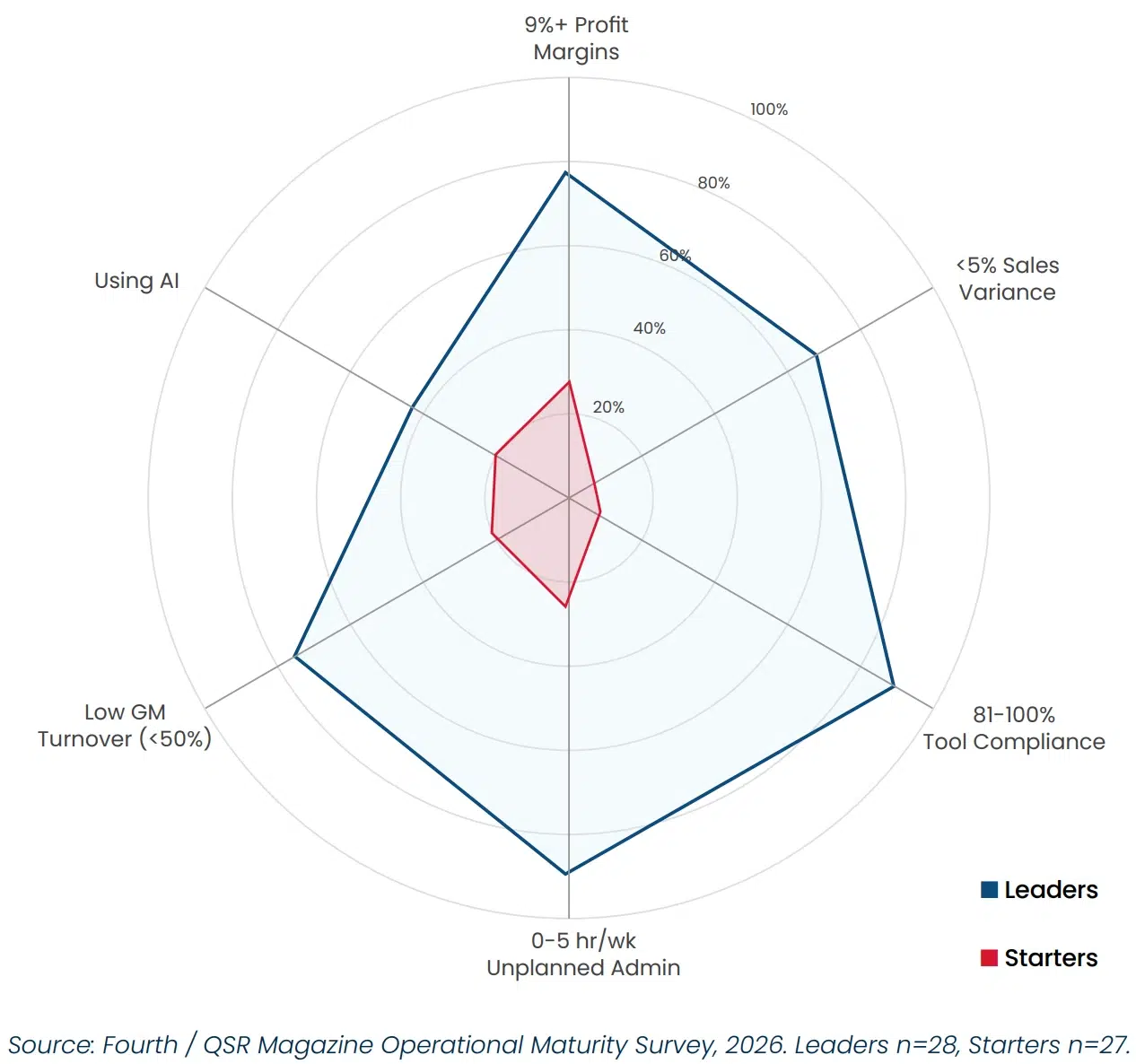
86% Tool Compliance (Top Tier) vs. just 11% for the bottom tier
75% Report 9%+ Margins (Top Tier) vs. 30% for the bottom tier
89% Low Unplanned Admin (Top Tier) 0–5 hrs/wk vs. only 26% for the bottom tier

The core finding: The biggest differentiator between the highest- and lowest-performing operators is not AI adoption, brand size, or technology spend — it is tool discipline. The most mature operators are 8x more likely to report full tool compliance across their locations.

Leaders vs. Starters: Key Metrics

chart showing the difference between AI leaders and starters

The AI & Automation Divide

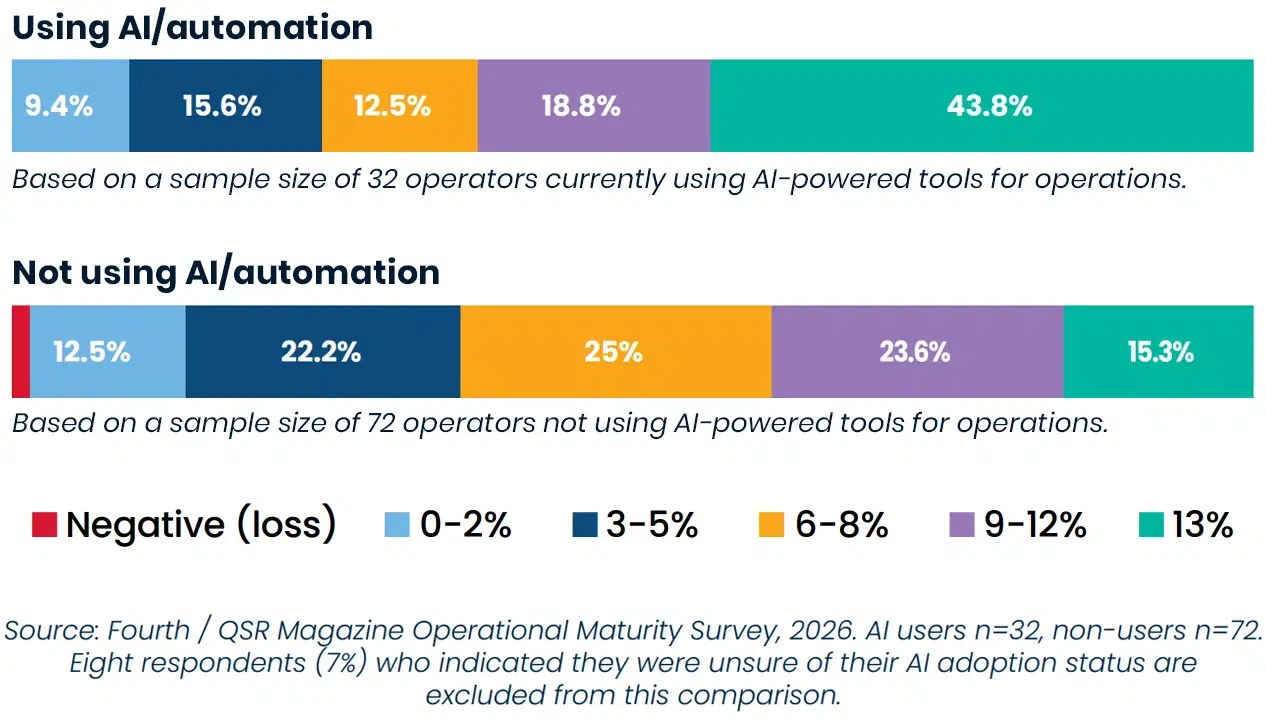
Nearly two-thirds of operators have not deployed AI or automation tools for operations. Yet among those who have, the profitability difference is striking.

AI-adopting operators are nearly 3x more likely to report profit margins above 13% than non-adopters. But AI adoption alone does not separate the maturity tiers — tool discipline does.

The bottom line: AI amplifies the advantage for operators who already have strong operational foundations. Without consistent tool discipline across locations, technology investments underperform.

Profit Margins: AI Adopters vs. Non-Adopters

chart showing the difference in profits between AI adopters and AI avoiders
Forecast
People
Execution
Profit

How do your four pillars stack up?

See Where You Stand

Take the Operational Maturity Scorecard to benchmark your brand across the four pillars and get personalized results in minutes.

Free · No login required · Results in under 5 minutes

About This Research

The State of Restaurant Operations 2026 is a benchmark survey of 100+ restaurant leaders conducted in partnership with QSR Magazine and WTWH Media. Respondents include C-suite executives, directors, and owners across brands ranging from single-unit operators to 500+ location chains. Over half oversee 20 or more locations, and one third operate within brands managing 100 to 500+ restaurants.

The study was developed by Fourth, whose platform connects every part of a restaurant’s operation — people, product, and profit — into one AI-powered system spanning workforce management, inventory operations, and demand forecasting across thousands of locations.